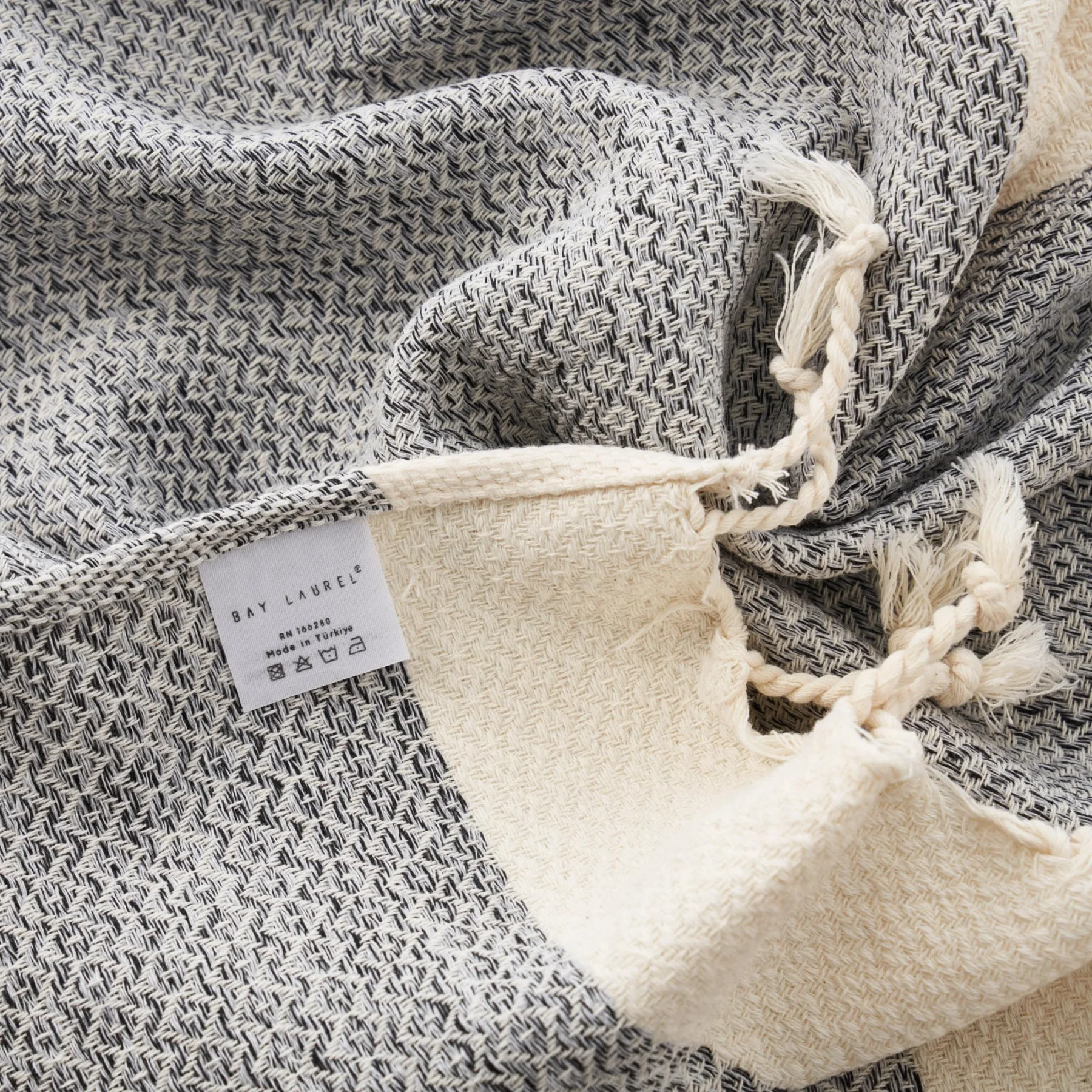
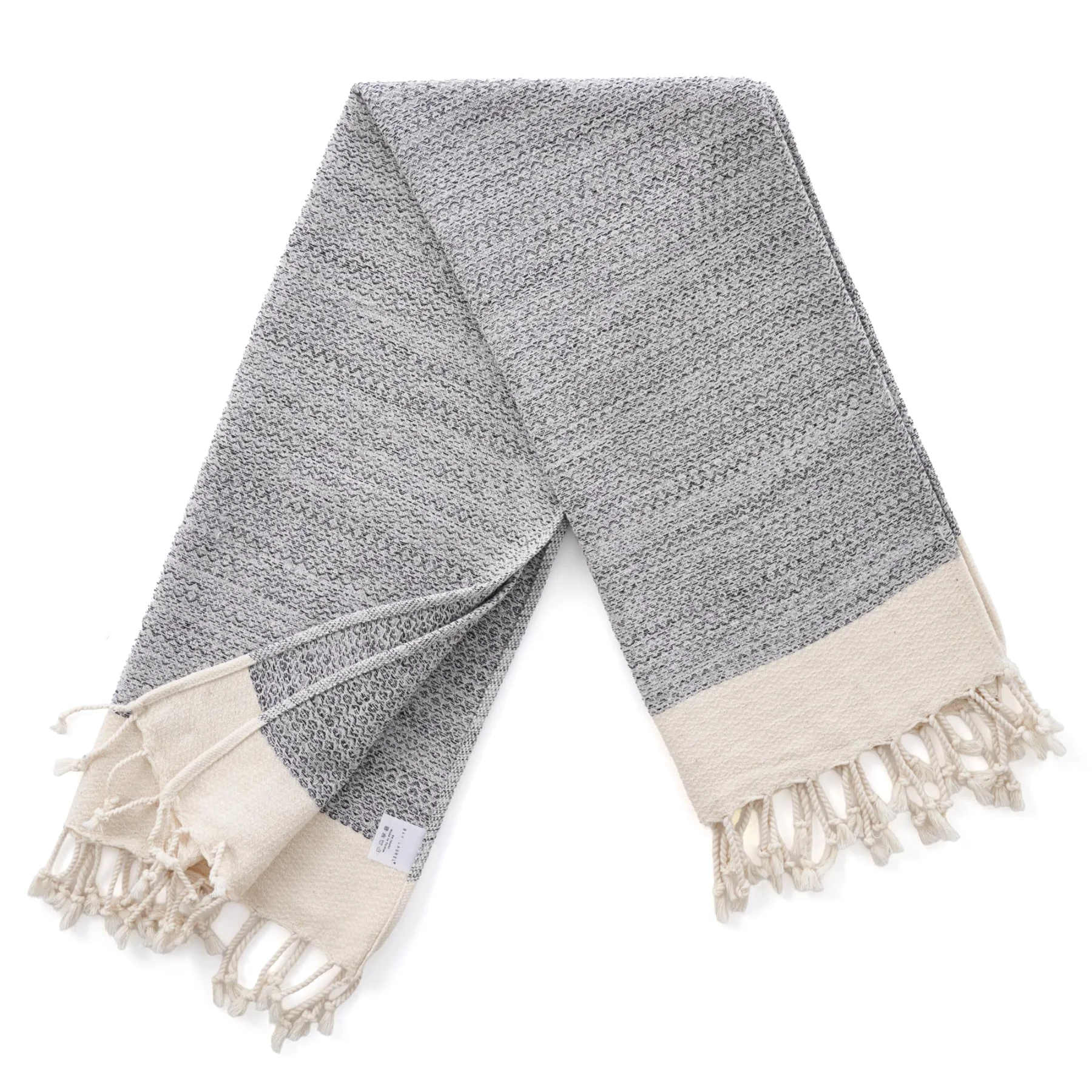
A Bay Laurel towel is a rectangle of flat cotton cloth, with knotted fringe along both short ends. No loops. No pile. The same on both faces, so there is no front or back to keep straight. It is a plain, honest object, and its personality comes from what it is not: it is not a pile towel.
What a Pile Towel Is For
Most towels Americans grow up with are pile towels. Terry cloth, the texture everyone recognizes from hotel bathrooms and pool bags, is made by looping yarn up off a woven base cloth and leaving those loops standing. The loops are the working part of the towel. Each one is a small cup, open at the top. Press a pile towel against wet skin and water wicks into the spaces between the loops. The cloth holds it there long enough to pull moisture off. This is a genuine talent. For drying off after a shower, nothing has really improved on it. We are not here to pretend otherwise.
But the same cups that hold water hold everything else too. That is the trade that pile makes. Sand works its way down between the loops and settles at the base, out of reach of a quick rinse. Grit embeds itself the same way. Over months of use, a pile towel accumulates a fine layer of old soap and sunscreen, with whatever grit the beach blew into it. Rinsing helps the surface. It does not reach the base of the loops.
Water is the bigger problem. The loops hold water so well that they hold it too long. A pile towel stays damp for hours after use. Folded into a bag, it stays damp. That is where the musty smell comes from: not the towel itself, but the water it refuses to let go of. Plenty of people solve this by hanging the towel straight away, which works. But a beach towel that has to be hung up the moment it is done is a beach towel that has to be managed.
Pile also costs weight and thickness. Those standing loops are a second set of yarns laid on top of the base cloth. So a pile towel of any given size is heavier and bulkier than a flat one. For a towel that lives in a bathroom and never travels, that bulk is fine. For a towel meant to pack small and dry fast, it is a disadvantage built into the construction.
What a Flat Weave Does Instead
| Diamond weave | Herringbone weave | |
|---|---|---|
| Pattern | Small lozenges repeating across the cloth | A twill that steps back on itself in a chevron |
| At three feet | Reads as texture, almost plain | Reads as a directional stripe |
| In the hand | Even and slightly grainy | Softer feel, a visible diagonal |
| Sizes we weave it in | 15 × 26 in and 16 × 40 in | 15 × 26 in and 16 × 40 in |
| Options in the catalogue | 29 | 17 |
Both weaves are sold in pairs, cream-bodied with a colored band, fringe knotted by hand.
A flat weave needs no loops because it works on a different principle. The cloth is built from two sets of threads. The warp runs the full length of the towel. The weft crosses it at right angles, over one warp thread, under the next, in a repeating pattern. Where a pile towel has a second layer of yarn standing up off the cloth, a flat weave has only the cloth itself. The surface is a surface, not a field of cups.
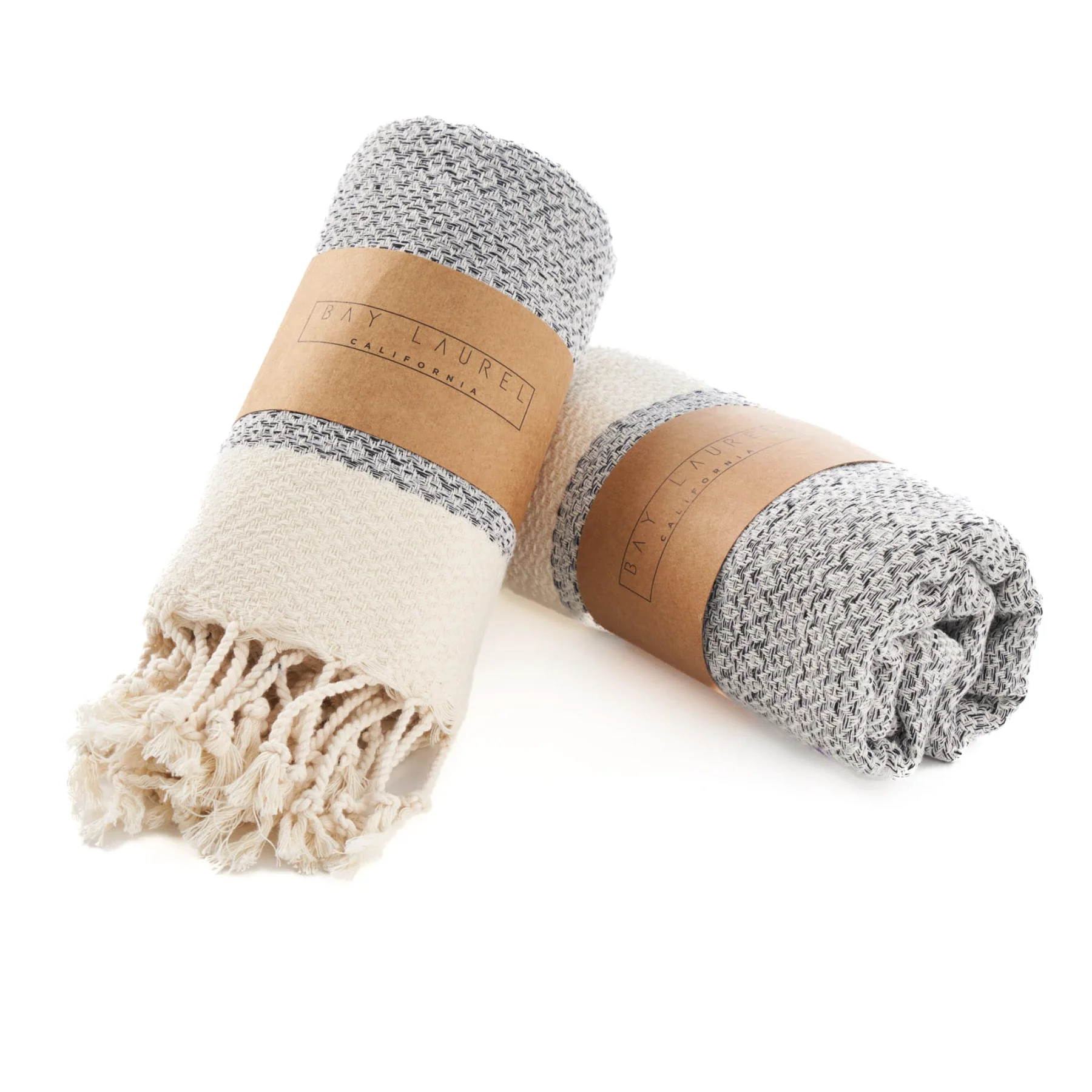
At Bay Laurel we weave our hand towels in two such patterns. The diamond weave, as the name suggests, produces small repeating diamonds across the cloth. The herringbone weave makes the familiar angled zigzag that looks like the bones of a fish. Both come in pairs and in two sizes: 15 by 26 inches and 16 by 40 inches. The beach towel, 39 by 71 inches, uses the same flat construction on a larger scale. All of it is woven in Türkiye, from Turkish yarn.
Water behaves differently on that cloth. Instead of being captured in loops and held in place, it travels. Water moves along the cotton fibers themselves, wicking across the surface and through the weave. A flat towel wipes water off skin the way a cotton shirt does: it spreads the water through the cloth instead of trapping it where it landed. You can feel it in use. The towel moves over wet skin, takes up water as it goes, and the water keeps moving, distributing itself across the whole rectangle. No one spot gets saturated and stops working.
That spreading matters later, too. Water spread over a large surface evaporates faster than water pooled in cups, so the towel dries quickly. A towel that dries quickly does not go musty at the bottom of a bag, and a towel that has no loops gives sand nowhere to hide. Sand sits on the surface of a flat weave. A shake sends most of it off. What remains rinses out in seconds.
The same square footage of cloth ends up lighter and thinner, because there is only one layer of yarn doing the work. The hand towels are pre-washed, so shrinkage is minimal from the first use. The beach towel packs flat and small, folds into a corner of a bag without complaint, and dries out before the next swim. That is the whole trick. It is not magic. It is just a weave that lets the water go.
Two Weaves, Two Hands
The hand towel line uses two weave patterns, and they are not interchangeable. Both are flat weaves in the same cream body with a colored band, but the structure of each changes how the cloth feels, how fast it softens, and how it reads on a hook across the room.
The hand towel line uses two weave patterns, and they are not interchangeable.
The diamond weave interlocks the threads so the pattern builds small lozenges across the surface. Run a palm over it and you feel a fine, even texture, like cloth that has already had some use. The interlacing is tight, which gives the towel body. It holds its shape on a bar and does not cling to itself in the wash. The diamonds are small enough that from a foot away they read as texture rather than pattern. From three feet the cloth looks almost solid, with a quiet depth that shifts as the light moves. The colored band reads clearly against that even ground, which is part of why the diamond towels look composed. They suit a guest bath or a linen closet where the towel should settle into the room without announcing itself.
The herringbone is the livelier weave. It is a twill that steps back on itself, so the diagonal changes direction in a chevron across the cloth. The surface has a raised rib you can feel more clearly than the diamonds. It catches the light differently, and it breaks in faster. The ribbed structure flexes as you use it, so the towel softens sooner under regular washing. From three feet the herringbone is unmistakable. The chevron reads as a deliberate pattern, a small visual event on a cream ground, and the colored band sits on top of it like a border on a printed page. It is the towel you notice when you walk into the room.
Both weaves are pre-washed before they reach you, so shrinkage from first use is minimal. The difference is in the hand. The diamond is smooth and even. The herringbone is ridged and a little more tactile. Bay Laurel keeps both in the line for that reason. People who dry their hands on both tend to prefer one, and it is rarely the same one.
The Fringe
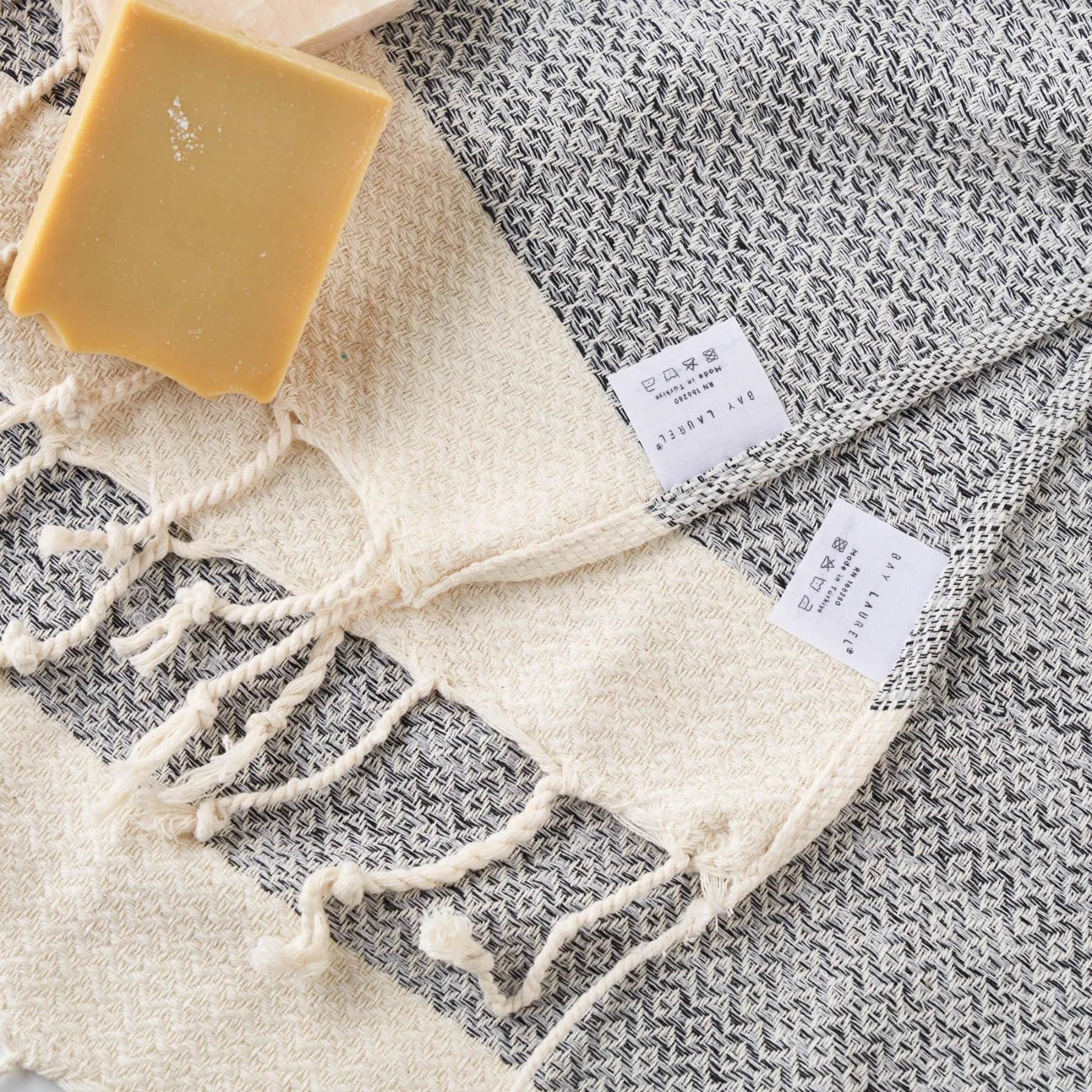
The fringe is not decoration added after the fact. It is where the cloth begins. On a shuttle loom the warp threads run the full length of the towel, and at both ends they are left long, then knotted by hand. On Bay Laurel's hand towels those knots are tied by women who work from home in the weaving district. Each knot is individual, so no two fringes are identical. That is not a flaw. It is the signature of the cloth.
A knotted fringe does something a stitched hem cannot. A hem sews the edge shut and stops the weave from unraveling, but it seals the cloth. The fringe leaves the warp threads open, and the knots give them weight. The towel hangs differently because of it. The fringe pulls the ends down slightly, so the cloth drapes instead of lying flat. It also lets the towel dry faster at the edges, because no doubled layer of fabric holds moisture against itself.
In the wash the fringe behaves well if you give it a little room. The knots tighten as they dry, and the threads can twist around each other. Tangles happen, especially if the towel is washed with heavy items that pull at it. The fix is simple. Before you hang the towel to dry, give the fringe a gentle shake and separate the knots with your fingers. If they have twisted into a rope, work them apart while the cloth is still damp. Do not pull hard. The knots are tied to hold, but the threads are yarn, and rough handling will fray them.
The towels photographed through this piece come from Bay Laurel towels, where the same weave runs through all three lines.
If a tangle has dried in, wet the fringe briefly and try again. The yarn relaxes when wet, and the knots come apart more easily. Some people trim a stray thread here and there. That is fine. The fringe will not unravel, because the knots are what hold it, not the cut. What you want to avoid is cutting the knots themselves. Once a knot is cut, the thread has nothing to hold it, and the weave loosens at the edge.
With age the fringe gets neater. The knots tighten on themselves and settle into a regular rhythm, which is part of the pleasure of a hand-knotted towel. It looks softer, more settled, the way a good cloth does after a season of use. The hand towels come in pairs, in two sizes, 15 by 26 and 16 by 40 inches, with a cream body and a colored band. The fringe is the last thing tied before they are folded.
The Weaving Districts of Western Türkiye
The cloth comes from the western end of Türkiye, where the Aegean coast meets the inland plain. The weaving towns sit in two loose clusters. One follows the coast and the low hills behind it. The other lies inland, around Denizli, a city known for cotton for a long time. Together they have been weaving cotton cloth on shuttle looms for generations. Much of the work happens in small workshops with a few looms. Some happens in houses, where a family keeps a loom and works it between other obligations.
The cotton itself is Turkish, grown in the same broad region. It arrives at the workshops as yarn, already spun and dyed in the colors the season calls for. The looms are shuttle looms, the older kind. A shuttle carries the weft thread back and forth across the warp, which is what gives flat weave its tight, even surface. The looms are not fast. A weaver can watch the cloth grow, row by row, and can catch a problem while it is still a few inches of cloth rather than a whole bolt.
The region's history with cloth is deep enough that one local cotton fabric carries a registered geographical name in Türkiye. The registration was issued in 2016 to the local chamber of commerce, which means the name is protected and can only be used for cloth made in that district in the traditional way. We mention it because it says something about how long these towns have been at this work. Bay Laurel weaves in these districts, but we do not claim that name for our own towels. The registration belongs to that cloth and that place. What we share with them is the ground and the looms and the habit of working slowly.
The people who weave for us are not a single workshop. They are several, spread across the district. What they have in common is that they run shuttle looms and they know how to read a colorway from a sample length. We order cloth the way the district has always ordered it: by the piece, with a sample first.
From the Loom to a Folded Towel
The season starts before the weaving does. A few months ahead, we order sample lengths in the colors we are considering. The samples are small, just enough to wash and handle. They arrive and we do a plain thing: wash them in the machine at home, dry them, and see what happens. Some colors hold. Some dull down. Some bleed or shift. The ones that survive the wash get considered. The ones that do not get dropped, and we order a different shade. It is a slow way to choose colors, but it keeps the range narrow on purpose. The colors you see have already been through a home washing machine once or twice.
When the cloth is woven, it comes off the loom as a long piece. The weaving is done, but the towel is not. The piece is cut into towel lengths, and the cut edges are finished so they will not fray. Then the fringe is tied. This is hand work, done by women who take the cloth home and knot each fringe individually. It is the part of the towel that most people touch first. A hand-tied fringe sits differently than a machine-made one. It is less uniform, and that is the point. Each towel carries the small variations of a hand that has done this thousands of times and still does it one knot at a time.
After the fringe, the towels are washed and dried. This is not a finishing step we talk about, but it matters. Washing the cloth after weaving relaxes the yarns and sets the weave. It is why the hand towels are pre-washed, so the shrinking that is going to happen has already happened by the time the towel reaches you. The beach towels are not pre-washed to the same degree, so they soften and settle a little in their first wash at home. It is part of how flat weave behaves.
Then the folding. The towels are folded by hand, each one checked as it is folded. A pulled thread gets caught here. A fringe that came loose gets sent back. The beach towels go into their drawstring bags, and the hand towels are paired into their packs of two. The sets are assembled the same way, towel by towel.
No one is rushing. The looms run at their own pace, the fringe is tied at someone's kitchen table, and the folding happens as it would in a house. That is how a towel gets made here, and it is why the towels behave the way they do. The cloth is tight because the loom is slow. The fringe is sturdy because it was tied by hand. The colors are true because they were washed in a home machine before they were ever offered to you. Bay Laurel is simply the small brand that stands between those workshops and your bathroom.
Choosing a Size and a Weave for Your House
The 39 by 71 inch beach towel is the most useful cloth in the line, and not only at the beach. Laid flat, it covers a lounger or a patch of sand with room to spare. Wrapped around you, it reaches from shoulder to mid-thigh on most people. Draped over a sofa or the foot of a bed, it works as a light throw on a cool evening. The flat weave means it does not grip the way a terry robe does, so a wrap stays where you put it with a tuck.
What it is not good at: being a bath sheet. The weave is thin by design, so it does not offer the heavy, padded feel that some people want after a shower. It also will not cover a king mattress as a blanket. Treat it as a large, quick-drying cloth, and it will serve you well.
The 15 by 26 inch hand towel, sold in pairs, is the size for a towel rail or a gym bag. It dries fast and takes up almost no space, which makes it a sensible pick for a half bath where a thick towel never quite dries between visits. In a gym bag, it is the one you reach for after a swim or a run, and the flat weave means sand and grit shake off rather than embedding in the cloth.
Its limitation is reach. At 15 by 26 inches, it is not long enough to wrap around your head or to use as a modest shoulder cover. It is a hand towel, and it stays in that lane.
The 16 by 40 inch version, also sold in pairs, is the middle ground. It is long enough to wrap around wet hair and twist into a turban, which makes it a favorite for washing your face or after a shower. In a guest bathroom, the extra length reads as more generous than the smaller size. Hung on a hook by a back door, it serves as a quick wipe for hands or paws without looking like an afterthought.
It is not a bath towel. At 16 inches wide, it will not wrap around a body. And while it is longer than the small hand towel, it is still a hand towel, not a bath sheet. If you want a cloth to dry off with, the beach towel is the one.
What Changes in the First Year
A new flat-woven towel starts crisp. The yarn is tight, the surface is smooth, and the cloth feels almost stiff when you unfold it. That is normal. With washing and use, the weave relaxes and the cloth softens noticeably. It will never become plush like terry, but it develops a supple, almost linen-like drape that many people prefer.
The fringe settles too. On the beach towels, the hand-knotted fringe arrives neat and even. After a few washes and a season of use, the knots loosen slightly and the fringe takes on a lived-in look. The hand towels, with their individually tied fringe, behave the same way. This is not wear. It is the cloth finding its natural shape.
Color is the one thing that asks for a small amount of care. The dyes hold well, but any colored cloth fades faster in direct sun. A towel hung on a line in full afternoon light will lose some depth over a year. The same towel dried in shade or indoors will keep its color much longer. This is true of all woven goods, and it is worth knowing if a particular colorway matters to you.
The most interesting change is structural. A flat weave that has been washed thirty times still folds flat. It stacks neatly on a shelf, rolls tightly for a bag, and lies smooth on a hook. A terry towel of the same age has thickened and stiffened. The loops trap detergent residue, the fabric grows heavier, and the towel develops a board-like feel that no amount of softening restores. The flat weave avoids this entirely. It stays thin, stays flexible, and keeps its shape because there is no pile to mat down.
The hand towels are pre-washed before they reach you, so shrinkage is minimal from the first use. The beach towels settle a little in the first wash, which is typical of natural fiber, but the flat weave means there is not much bulk to lose. What you see at purchase is close to what you get for years.
The cloth from Bay Laurel is made in Türkiye, woven from Turkish yarn on shuttle looms in the Aegean weaving districts, and the fringe is knotted by hand. None of that changes with time. What changes is the feel, and it changes in the right direction. A year in, the towel is softer, the fringe is settled, and the weave still folds flat. That is the whole point of a flat weave, and it is why the cloth earns its place in a household.