
The towel comes out of the car with one good shake, and you think that's that. You fold it, toss it in the trunk, and it rides home quiet. But October rolls around and you're still finding sand in the footwell. Tiny grains, pale and stubborn, tucked into the carpet like they own the place. You never saw them arrive. They came from a towel you shook out at the beach, or a bag you packed straight from the sand, or a pair of shorts that spent an afternoon on a blanket. The sand always finds a way. The question is why.
What beach sand is, at the scale of a towel
Beach sand isn't one thing. It's a mix of particles, some fine as flour, some coarse enough to feel like gravel. On a young beach, the grains are angular, freshly broken from rock and shell. On an old shoreline, they've been tumbled for centuries, rounded and smooth. Each grain has its own shape, its own weight, its own habit of catching on things.
A terry towel is a field of loops. Cotton loops stand upright, and between them are gaps. When you dry off, sand grains slide into those gaps. They settle at the base of the loops, snug against the weave. Shaking the towel moves the top layer of loops, but the grains at the bottom stay put. They've found a pocket, and they're not leaving until the towel goes through a wash. That's why the car floor ends up with a layer of grit. It's not that you didn't shake hard enough. It's that the towel's surface was built to hold onto sand.

The loops act like a series of tiny cups. Each one catches a few grains and holds them. The more you shake, the more the loops flex, but the grains stay wedged at the base, where the loop meets the ground cloth. They don't have to be big to resist. A grain the size of a pinhead has plenty of purchase in a cotton loop. And there are thousands of loops per square inch. Multiply that by the number of times you've dried off over a summer, and you have a beach that follows you home.
What a flat weave changes
Flat weave is a different geometry. Instead of a field of loops, you get a closed, even surface. The weft threads pass over and under the warp, and there are no raised piles, no gaps for a grain to drop into. Sand lands on top of the cloth. It sits there, resting on the weave, not tucked inside it. One sharp snap of the towel, and most of it lifts off. The grains have nowhere to hide. They tumble away with the motion, and the cloth comes away clean.
That's the principle behind our Bay Laurel beach towel, a 39 by 71 inch flat-woven cotton towel with a knotted fringe and a drawstring bag. It packs down small because it's flat, and it shakes out fast for the same reason. The weave is dense enough to feel substantial, but the surface has no pile to trap debris. Sand that lands on it stays on top, and a single motion clears the majority of it. You don't need to beat the towel against a railing or spend ten minutes picking at it. You snap it once, and the worst is over.
But there's a limit. Wet sand on wet cloth is a different story. When both are damp, the sand sticks to the cotton by surface tension. The grains don't drop between loops, but they don't fly off with a snap either. They cling until both the towel and the sand dry out. Once they dry, the sand loosens and shakes free. So the flat weave isn't a magic trick. It's a better arrangement for dry sand, and a fair one for wet. The honest trade-off is that you might need to let a damp towel sit for a few minutes before you give it that final shake. But the sand that does come off comes off completely, not in a thin layer that leaves the rest behind.
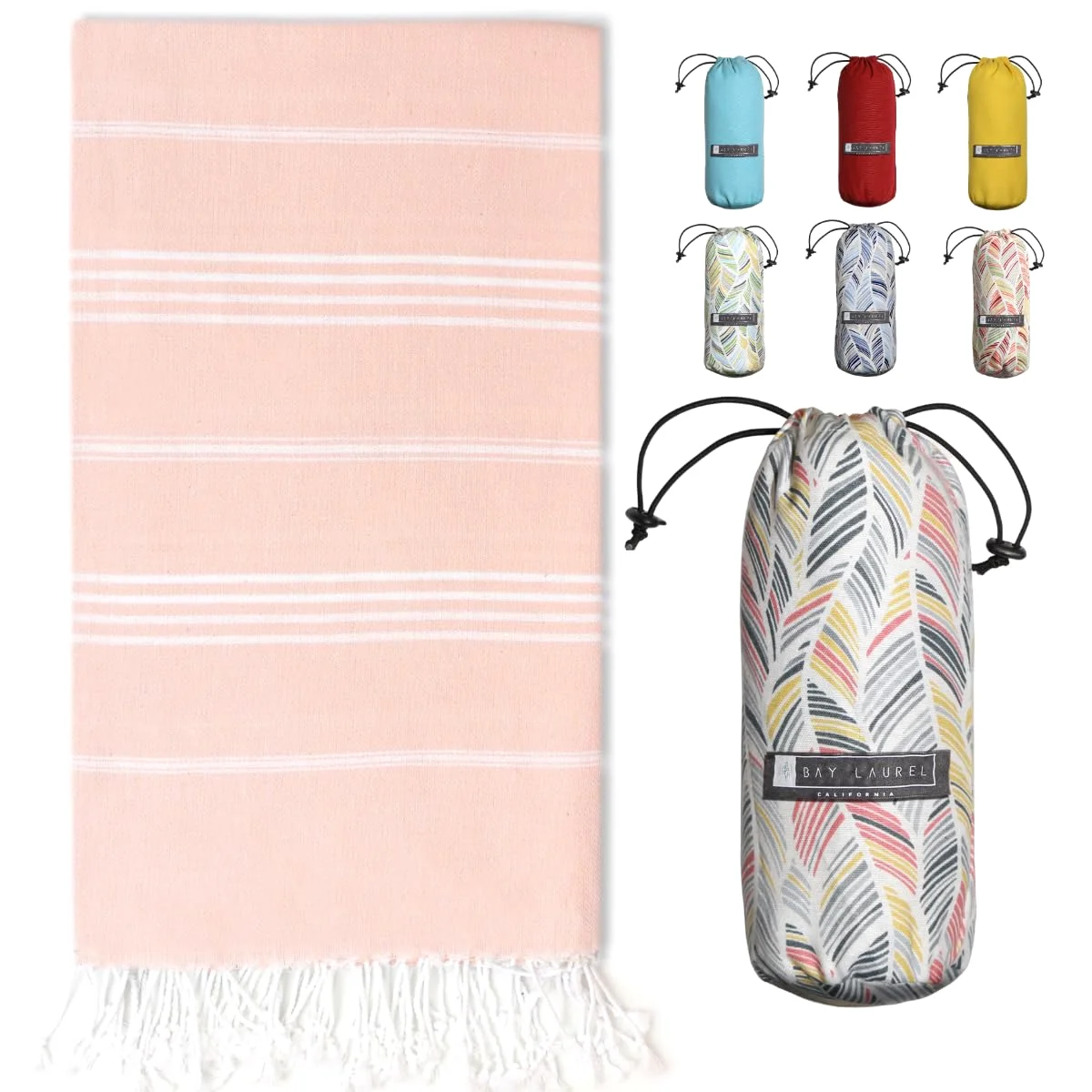
The other thing flat weave changes is the way the towel carries itself. Without the bulk of a pile, it folds into a tighter shape and dries faster. That matters on a beach trip, where the towel goes back into its bag while still a little damp. A terry towel stays wet for hours and develops a sour smell by evening. A flat weave dries quickly enough that the musty note never arrives. That's not a claim about laboratory numbers. It's just what happens when you let air move through a thin cloth instead of a thick one. The sand issue and the drying issue are connected. Both come down to the same design choice: no pile, no place for debris to lodge, no thickness for moisture to linger.
Drying, and What It Changes
| Situation | What a flat weave does | What to expect |
|---|---|---|
| Dry sand on dry cloth | Grains sit on the surface | One snap of the towel clears most of it |
| Wet sand on wet cloth | Grains stick to the film of water | Wait until both are dry, then shake |
| Sand in the fringe | Knots catch grains the field does not | Run the fringe through your fingers |
| Salt water | Dries into the fibres as crystals | Rinse before it dries, or wash that evening |
| Sunscreen | Oil sits in the weave and marks pale shades | Wash the same day where you can |
Behaviour, not laboratory figures. Nothing here has been measured with a stopwatch.
The towel dries fast because it has less water to give up. That is the plain arithmetic of a flat weave. The towels are thin and have no pile. Water sits on the surface in a thin sheet, not in loops. A thin sheet of water meets the air sooner than water pooled in the deep. More surface for the air means the water leaves sooner. The towel gives it a lot of surface.
The air time is the second half. Terry cloth holds water in its loops, and the loops sit deep in the cloth. Air reaches them slowly. The water stays. At home that is fine, where you can hang a terry towel for two days. It is not fine in a bag. Two days into the trip, the wet towel has been sitting in its own still, warm air. The water has nowhere to drain, and a wet cloth will eventually smell. The flat weave does not have the pile to hold the water. It gives the water up to the surface, and on a rail overnight it is dry by morning. The bag does not smell. The towel does not sour. Nothing is left to turn.
That changes what you pack. If the towel dries overnight, you pack it in the morning and forget it. If it does not, you carry a damp cloth through the day, and a damp cloth touches other things. The book. The shirt. The bag itself. The morning is the decision. A Bay Laurel towel decides it on the good side.
That changes what you pack.
So the question is not how many minutes it takes. Minutes depend on weather and air, and those vary. The question is behavior. Does the towel dry on a rail overnight? This one does. Does it smell on the third day? This one does not. A thin cloth with no pile gives up its water, and that is the whole story. The rail is the right place for it. The bag is the wrong place for a wet towel. The flat weave is what keeps them apart.
Packing, and What Fits Now
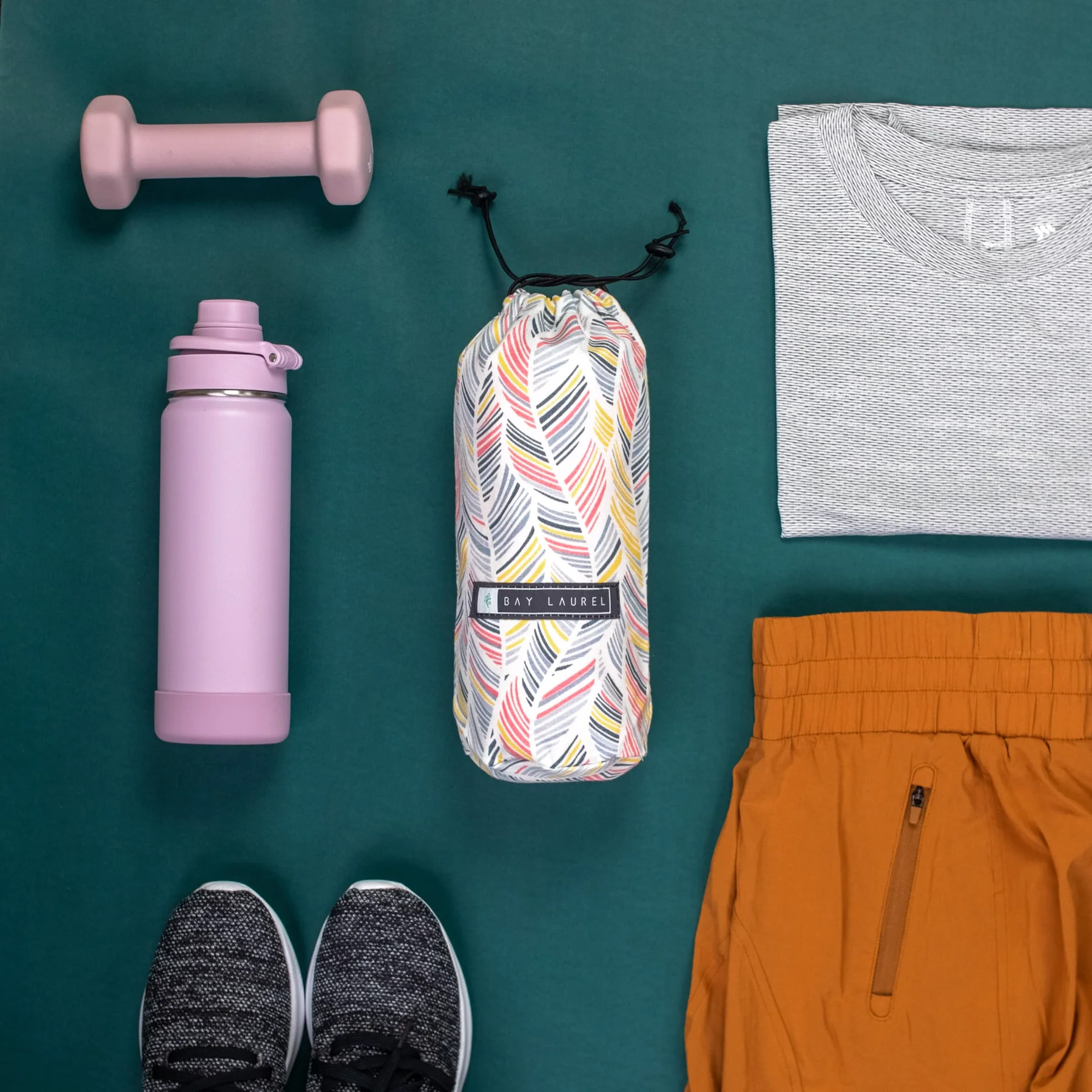
The beach towel is 39 by 71 inches, a flat shape that sounds like the largest thing you would carry to a beach. It folds into a drawstring bag about 11.5 inches tall and 4 inches across. That is smaller than a bottle of sunscreen. That changes what the day bag has room for. The towel stops being the biggest thing in it.
When the towel is not the biggest thing, you pack differently. You pack the bottle, the sandwich, the book, the sandals, the spare shirt. They all fit because the towel is not the object you have to work around. The drawstring bag makes that possible. It keeps the towel in one shape. It keeps the wet from the sand, the sand from the rest of the bag, and the day bag open for everything else.
For a family, four towels are four bags. That is not a packing trick. It is a wetness decision. Three of the four are wet when you leave the beach. If they all share one large bag, the wet ones soak the dry one, and the dry one is not dry for long. Four separate bags mean each towel is alone. The wet ones stay wet. The dry one stays dry. The wet ones hang on the rail, each in its own bag, and dry on their own schedule. The family does not wait for all four to be dry before moving on.
Bay Laurel sells the four-packs for this reason. Each towel has its own bag, and the four bags come together like four things. There is also a bundle of four with a bonus single towel, for when the count is odd. The question stops being how to carry four towels. It becomes which colors belong to which person.
The bag changes the day of the beach too. The towel is in the bag, the bag is in the day pack, and the hands are free. The sand stays on the towel. The wet stays in the bag. The car seat stays dry. Two days in, the towel is fresh and the bag does not smell. None of this is about minutes. It is about the geometry of the cloth and the size of the bag, and how both change the order of the day.
The towels photographed through this piece come from the Bay Laurel catalogue, where the same weave runs through all three lines.
The Beach Day, in Order
You spread the cloth on dry sand first. The flat weave settles where you put it, and sand that touches the surface falls off instead of clinging. On a lounger, the same cloth drapes over the straps and padding without sliding much, because the weave grips slightly against the plastic webbing. Either way, the towel is doing its job before you sit down.
Then the wind arrives. A 39 by 71 inch rectangle is a modest sail, not a kite. It lifts at the corners and flutters, but it won't launch across the beach the way a lighter, larger towel will. If you are alone, weight the corners with a shoe or a bag. The knotted fringe adds a little mass at the edges, which helps keep things anchored.
Two people can sit on one towel. The 71 inch length gives each person room to lean back without crowding, and the flat weave means you are not sitting on a thick pile that holds heat. On a hot day, that is a small mercy. The cloth stays where you put it, and when you stand up, most of the sand that found its way onto the surface shakes off in one motion.
The walk back is where the towel becomes something else. Fold it once, wrap it around your waist or shoulders, and the knotted fringe holds the fold in place. Both faces are the same, so there is no wrong side to worry about. It covers what needs covering and dries on you as you walk, faster than a terry towel will.
In the car, the towel has two jobs. Spread it over the seat to protect the upholstery from damp swimwear, or fold it and set it on the floor as a mat for sandy feet. The drawstring bag, about 11.5 inches tall and 4 inches across, is small enough to tuck into a door pocket or under a seat. The wet towel goes in the bag, and the bag keeps the rest of the car dry. When you get home, pull the towel out, hang it, and it is dry by morning. Bay Laurel's beach towel does all of this in any of its 43 colorways, and the bag it comes in is plain or printed depending on which one you pick.
The Same Towel, Away From the Beach
Poolside, the flat weave does what it does on sand. Water beads on the surface instead of soaking into a thick pile, and the cloth dries quickly in the sun. It is not plush under your back on a concrete deck, but it is lighter to carry and it won't stay damp for hours. A lake dock is the same story, with the added benefit that the towel shakes clean if it picks up dirt or leaves.
On a yoga mat, the towel works as a cover that adds grip without adding bulk. The flat weave stays put, and the knotted fringe at the ends gives you something to grab when you need a little extra purchase. It is not a mat in its own right, and it won't cushion a hard floor, but as a top layer it does fine.
As a picnic cloth, it is a better choice than a terry towel. Food spills wipe off the surface, and the weave doesn't hold crumbs the way pile does. The 39 by 71 inch size covers a good stretch of grass, and both faces being the same means you can flip it if one side gets dirty. It won't keep moisture from seeping through on wet ground, so bring a blanket underneath if the grass is damp.
On a plane, the towel becomes a blanket that folds small. The flat weave is thin, so it won't add much warmth, but it cuts the chill of cabin air and it packs into the drawstring bag when you are done. It is not a real blanket. It is a layer, and that is enough on most flights.
At a gym, the changing-room towel is where it falls short. A flat-woven cloth is fine for drying off after a quick rinse, but it is not the warm, thick towel you want after a cold shower in winter. It absorbs, it just doesn't wrap you in the same soft bulk. For the walk from the shower to the locker, it does the job. For comfort, it doesn't compare to a heavy terry towel, and that is honest.
At home, draped over the arm of a chair, it is a throw that adds a bit of color and a bit of warmth without being a blanket. The knotted fringe gives it a hand-finished look, and the flat weave means it doesn't shed. It is a small thing, but it is the kind of small thing that makes a room feel lived in.
Bay Laurel's beach towel is the same cloth in all of these places. It is not the answer to every towel problem, and it doesn't pretend to be. It is a flat-woven rectangle with knotted fringe, made in Türkiye, and it does what flat-woven cloth does: dries fast, packs small, and stays out of the way.
What the Beach Leaves in the Cloth
Salt is the first thing. Not the salt you can see on the skin, but the salt that dissolves into the water and crystallizes in the weave when the towel dries. Cotton holds onto it. Over a season, that salt works the fibers, stiffens them, and flattens the color, so a towel that started bright ends up gray.
Sunscreen is the second. It sinks into a flat weave easily, and the oils in it are the hardest thing a towel will deal with all summer. They darken the cloth over time, and on pale colors they leave a faint cast that a wash will not lift. Chlorine is the third, if your day ended at a pool. Chlorine works on the dye harder than the sun does. A summer of pool days will pull color out of a towel in a way salt never will.
Then there is the sand. You shake the towel at the beach and you think it is gone. It is not. Sand stays in the hand-knotted fringe and stays there. Dry sand in the fringe is not a problem while you are on the beach. It is a problem in September, when the sand has worked deep into the knots and it falls on the floor every time you lift the towel. It also grinds against the yarn like grit, and a towel folded with sand in it and left in a drawer for a month comes out with a stiff line at the folds.
The habits that deal with all four are simple. Rinse the towel in fresh water before it dries. That gets the salt out of the yarn while the crystals are still soft, and it lifts the sunscreen off the surface before it sets. Shake the cloth. Sand comes out of the fringe when the cloth is damp, and it does not come back once it is dry. And do not fold a wet towel into its bag and leave it for three days. The flat weave dries quickly, which helps, but a towel shut in a bag will still turn. Let it sit an hour on the line or the back of a chair, then pack it.
These are small habits, and they are the difference between a towel that looks the same in October and one that looks tired. Bay Laurel weaves the towels in Türkiye from Turkish yarn, and the flat weave is the reason these habits go as far as they do. A flat cloth rinses out and dries in a way a thick towel cannot.
Choosing a Color That Will Survive a Summer
Color is not only a matter of taste. The 43 colors in the beach line are not all the same in how they behave over a season of sun, salt, and sunscreen. Pale shades are the honest ones. They show everything. A pale gray, a cream, will record the sun, the faint cast, the slight flattening of the light. Some people like a towel that shows its use. If you do not, pick a darker one.
Dark shades hide the evidence, but they pay a different price. A deep navy or a black cloth holds the sun, and at the beach you are lying on it. It is warmer against the skin in the middle of the day. That is a real trade, not a cosmetic one.
The middle ground is the multi-colored weave. Seven of the 43 colorways are woven in several colors at once. These are the most forgiving towels in the line. A towel with a pattern in the warp does not show a season of use the way a solid color does. The small changes and the sunscreen just blend into the pattern. If you want one towel to go through a whole summer and still look right at the end of it, this is the one.
There is also the bag. Each towel comes with a drawstring travel bag, and the bags are plain or printed. If you have four of the same towel, the printed bag is the practical answer. On a crowded beach, plain bags look the same. A printed one tells you which is yours without turning over the pile. It is a small thing, and it saves a day.
The summer is a hard season on a towel. The right color does half the work, and the right habits do the rest. That is the whole point. A Bay Laurel towel is made for a season of sun, and the color you choose and the way you care for it are the two things that keep it looking like itself.