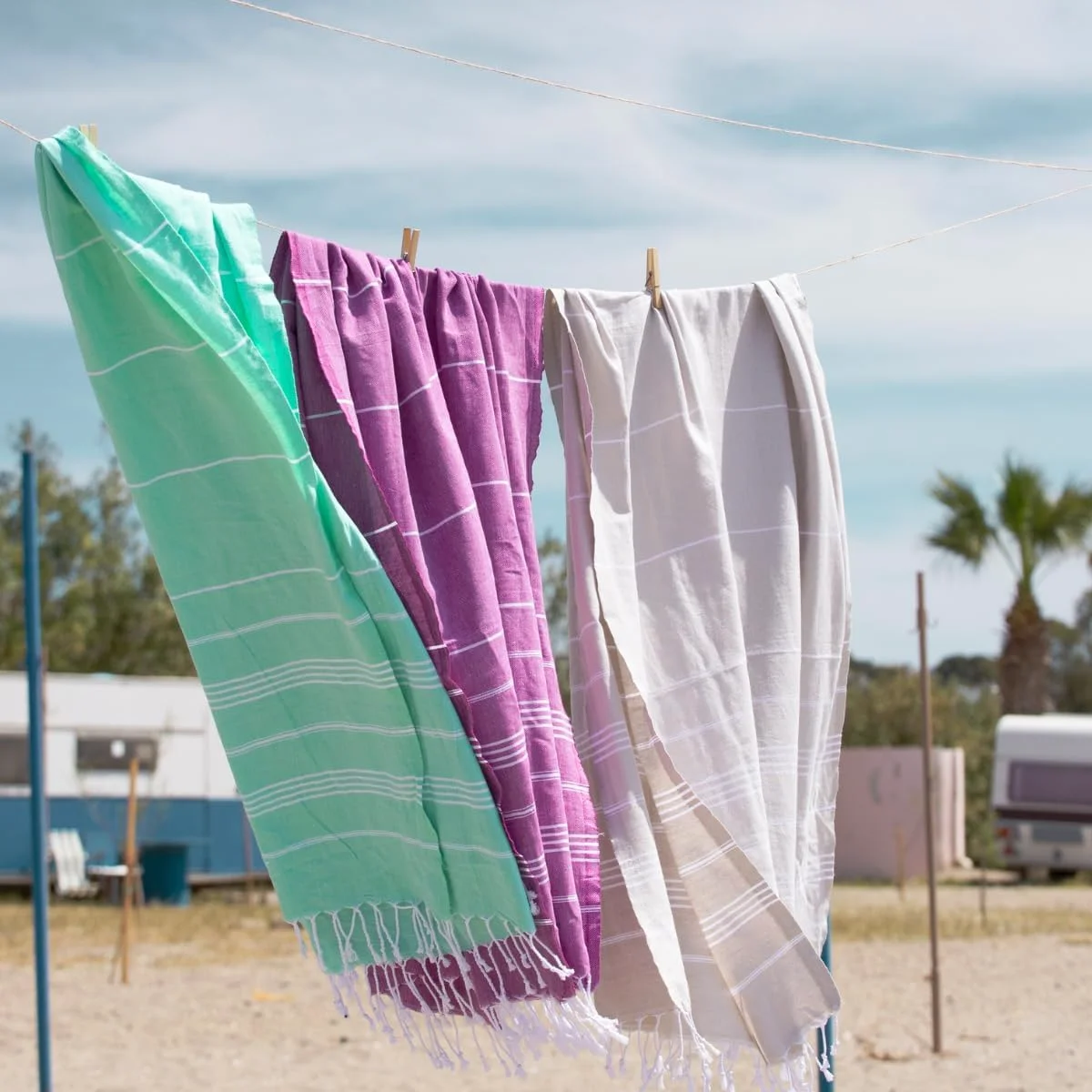
The towel comes out of its drawstring bag stiff and flat. It has a papery hand, a crispness that feels more like a tablecloth than something meant to dry your shoulders. If you have spent your life with terry cloth, this first impression can be a little confusing. You may wonder whether you bought the right thing. You did. This is what a new flat weave feels like before it has met water.
Turkish towels are woven, not looped. The cloth is a single flat surface, tight and smooth. There is no pile to brush against your skin, no loops to hold moisture. What there is, at first, is a certain formality. The towel lies flat on the bed or the chair and looks almost architectural. The hand-knotted fringe at the ends is the softest part of the whole piece. That will change. A Bay Laurel beach towel fresh from its bag is the stiffest version of itself it will ever be. Folded tight for travel, the weave is still holding the tension it was set with.
The first wash
Cotton is a fiber that remembers. It has been spun, woven, and finished, and all of that work has left it taut. The first wash relaxes some of that tension. The weave closes slightly, the threads settle into one another, and the cloth loses its papery stiffness. The hand softens, not dramatically, but perceptibly. A flat weave takes a few washes to reach its real character. This is the opposite of a pile towel, which is at its plushest on day one and declines from there. A terry loop is a small tower of cotton. Every wash wears the tips of those loops down. A flat weave has no pile to lose. It only gets better with use.
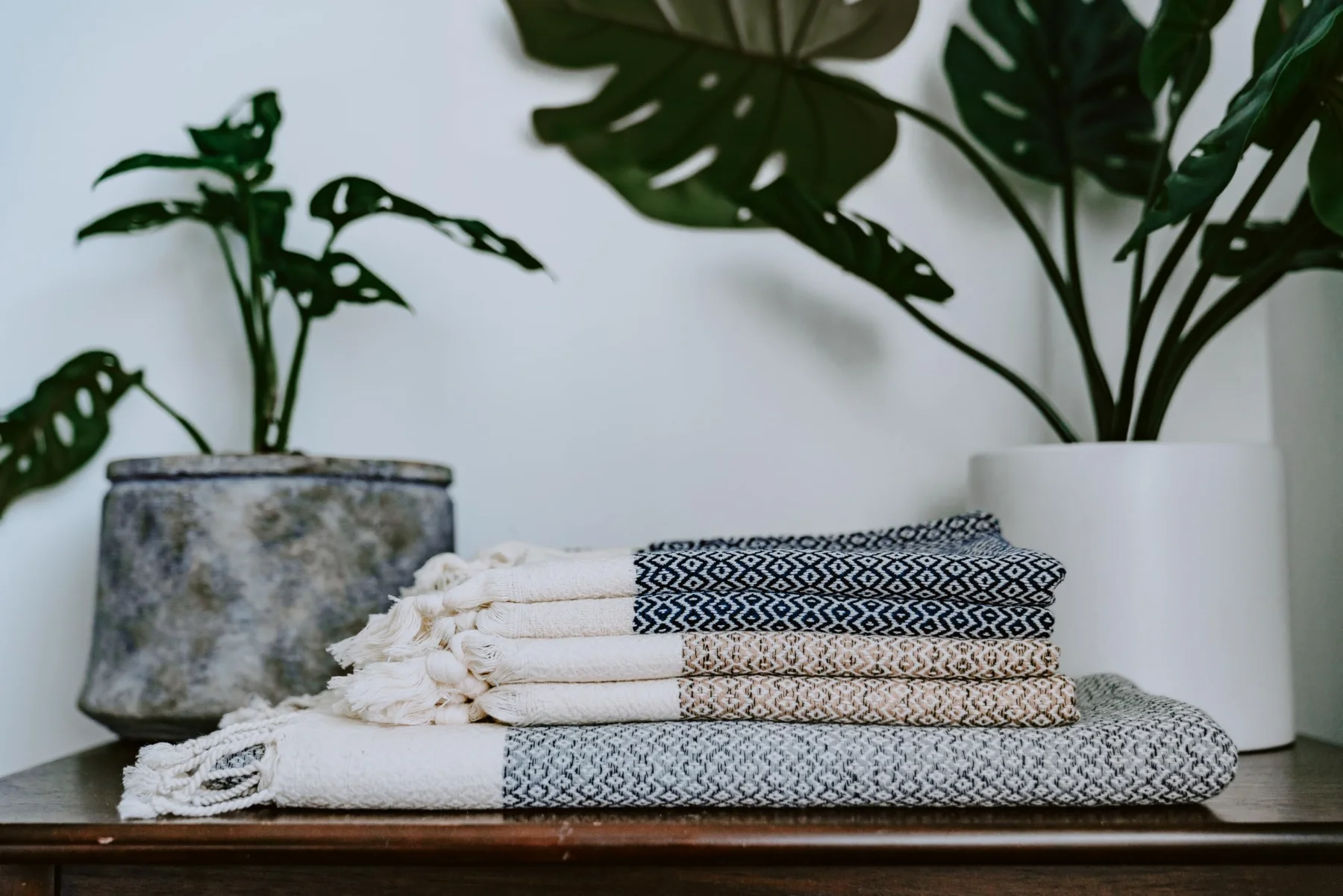
There is a particular pleasure in watching this happen. The first wash comes out of the machine looking much the same, but the second and third washes bring a visible change. The towel drapes a little differently over the rail. It folds into a smaller shape. The fringe loosens and starts to move with the cloth instead of sticking out stiffly. After a handful of washes, the towel has found its character. It is still flat and still smooth, but it no longer feels like paper. It feels like cloth.
Bay Laurel's hand towels are pre-washed before they are sold, so they arrive further along that curve than a beach towel straight from the bag. The beach towel will catch up. Give it a few washes and it will develop the same relaxed drape. The first wash is not a transformation. It is the beginning of a slow settling, a cloth finding its way into its own shape.
Softness without softener
| Do | Skip | |
|---|---|---|
| Washing | Full loads, colors together for the first few washes | Zippers and hooks in the same drum |
| Drying | A line, or the dryer on low | A long hot cycle |
| Softening | Use and time | Fabric softener and dryer sheets |
| Fringe | Comb it out with fingers | Pulling a snagged thread |
| Storage | Folded dry, flat on a shelf | Rolled damp in a bag for three days |
No temperatures are printed here because none are stated on the pack. Follow the label on your own towel.
Fabric softener is a coating. It lays a thin film over cotton fibers, which makes the cloth feel slick in the moment and then traps the very thing you are trying to avoid. A coated fiber is a less absorbent fiber. It also holds onto residue, which can make a towel feel stiff again once it dries. Dryer sheets do the same work in the dryer. If you bought a flat weave because it dries quickly and shakes sand off its surface, a coating works against both of those qualities. The whole point of a flat weave is that there is nothing for moisture to hide in. A softener film fills that open space.
What actually softens a flat weave is unglamorous: use, water, time. Each wash and each dry loosens the weave a little more. The cotton relaxes on its own schedule. Hanging the towel on a line lets air do the work, and the sun does not hurt. In a dryer, a low heat cycle is enough. High heat does nothing for a flat weave that time would not do better. The fibers are already flat. There is no loft to preserve, no pile to fluff. Heat only ages the cloth faster than it needs to.
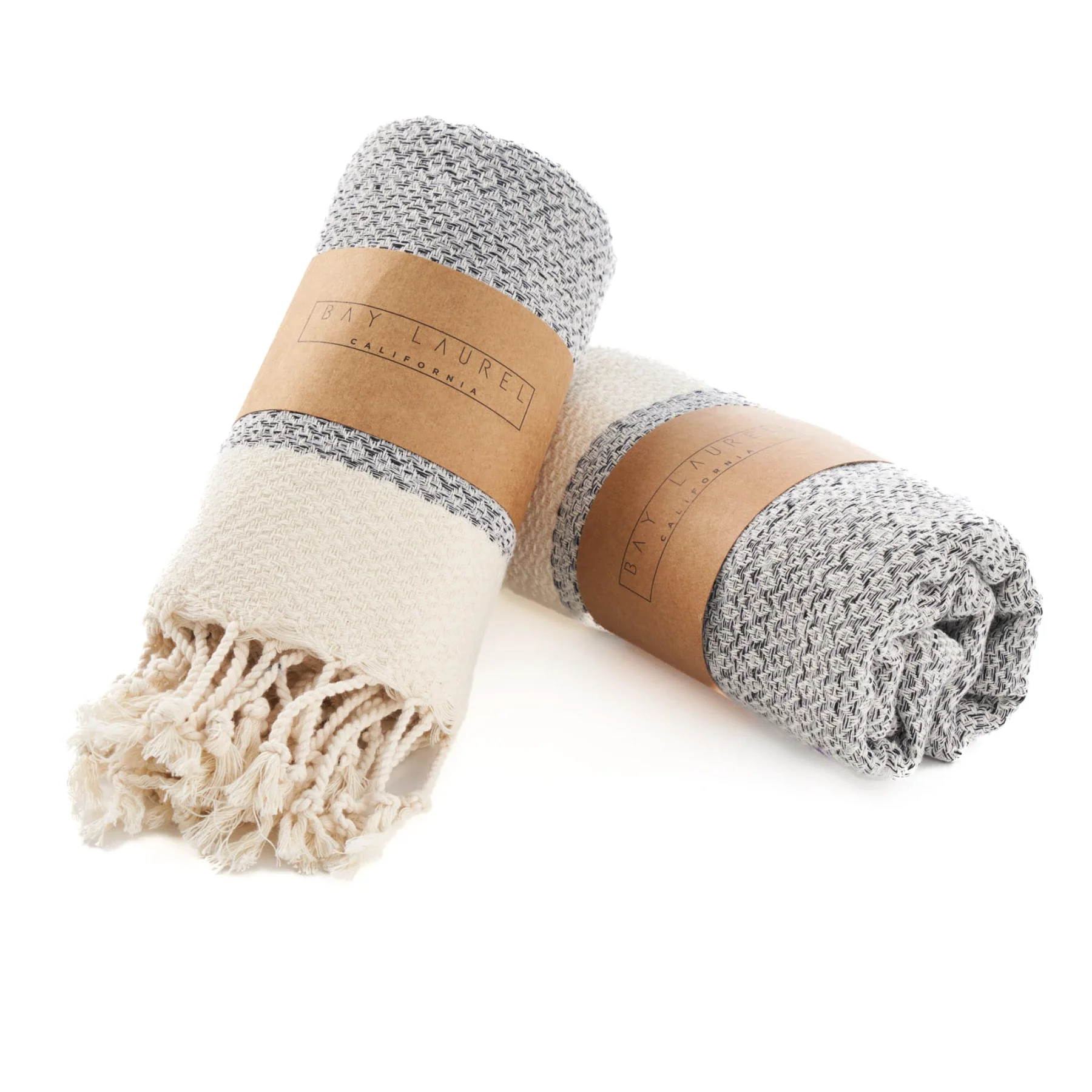
The hand you feel in the tenth year is not the hand you felt in the first week. It is softer, yes, but it is also more settled, more familiar. The towel has been washed dozens, maybe hundreds of times. It has dried you after a swim, dried your hair, been dragged to the beach and back. It has been used to wrap a loaf of bread on a picnic, to cover bare shoulders in an evening breeze, to sit on at a concert. The crispness is gone, replaced by something that feels like cloth that knows its job. And because the cloth does that work on its own, the owner's real job is mostly to stay out of the way. That, more than anything, is what living with a Turkish towel turns out to be.
A washing routine that works
Treat your Turkish towel like a living thing for the first few washes, and it will reward you for years. The opening of this article covered the initial bath and why you skip fabric softener. Now we get into the rhythms that keep the towel performing at its best.
For the first three or four washes, group your colored towels together. Turkish towels are woven with dyed yarns, and while modern dyes are far more stable than they used to be, the earliest washes can still release a little excess color. Mixing a deep indigo with a cream towel in that first cycle is a gamble you do not need to take. Keep like colors together until the water runs clear, which usually happens by the fourth or fifth wash.
Load size matters more than most people realize. A half load leaves towels sloshing around with too much room to twist and knot, and that motion is exactly what frays fringe and stresses the woven loops. A full load packs the towels together so they move as a mass rather than whipping against the drum. That sounds counterintuitive, but think about how a crowded bookshelf keeps books upright. The same principle applies here. Do not cram the drum to bursting, though. You want the towels to tumble freely, just with enough company to keep them from thrashing.
Load size matters more than most people realize.
Zippers and hooks are the enemies of a good towel. A stray metal clasp from a bathrobe or a bra hook can catch a single loop of weft and pull it halfway across the towel in one cycle. That is how you get a pulled thread that runs for inches. Before you load the machine, run your hand over any garments that will share the load. If something has exposed hardware, turn it inside out or better yet, wash those items separately. The few minutes of sorting save you from a towel that looks like a laddered stocking.
Drying is where most Turkish towels get their character, for better or worse. Line drying is the gentlest option and produces the crisp, flat texture that many people love. If you are drying indoors, drape the towel over a rack and give it room to breathe. A towel folded over a bar will take twice as long and may develop a musty smell.
If you prefer the machine, use low heat and let the cycle finish completely. Pulling a towel out while it is still warm and giving it a sharp snap will loosen the loops and restore some of the fluffiness that line drying removes. High heat is the one thing to avoid. It shrinks the cotton unevenly, stiffens the weave, and over time, it will weaken the yarns until the towel develops thin spots. A Turkish towel dried on low or hung on a line will soften more with every use. That is the whole trick. The towel is not a finished product when it leaves the loom. It becomes what you make of it through the habits you build.
The fringe, in detail
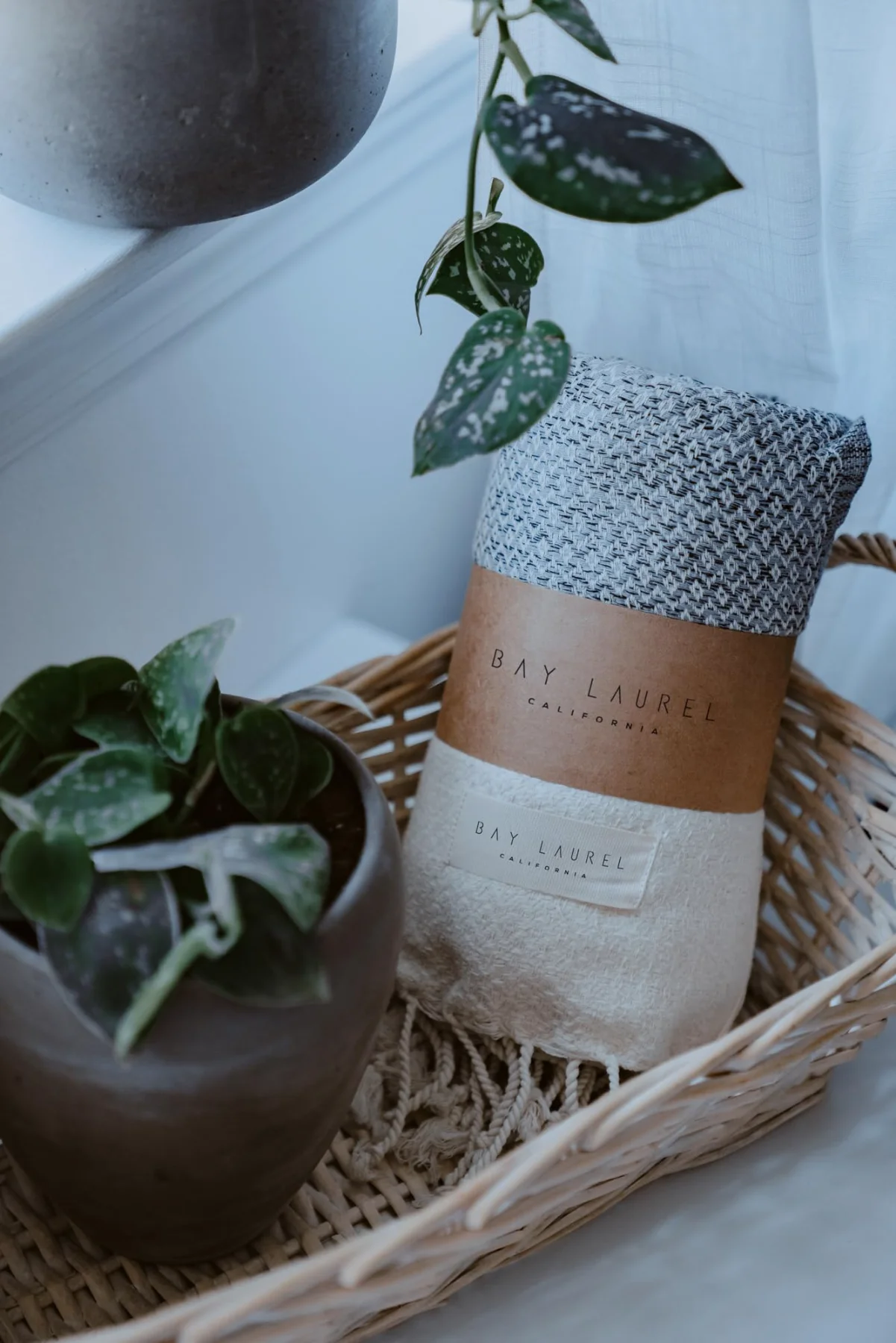
The fringe is the part of a Turkish towel that gets the most attention and causes the most anxiety. It is also the part most people misunderstand. The fringe is not decoration. It is the exposed warp ends, the same threads that run the entire length of the towel. When you see a towel with healthy, straight fringe, you are looking at a weave that has been handled with care.
What tangles the fringe? Water and motion, mostly. In the wash, wet warp threads cling to each other, and the spinning action twists them into cords. Those cords then knot into tight little bundles that seem impossible to undo. The fix is simple, but it requires patience. Before you fold the towel for storage, take a minute to shake it out and run your fingers through the fringe. This is not a chore. It is a thirty-second habit that keeps the threads from matting into permanent tangles.
When you do find a knot, use your fingers, not a brush. A brush, even a soft one, will catch and pull the warp threads, which can stretch them unevenly. Your fingers can feel the difference between a tangle and a knot, and they can work through the twist without yanking. Start at the bottom of the knot and work upward, gently teasing the threads apart. If the knot is stubborn, try wetting your fingers. Dampness relaxes the cotton fibers and makes them more pliable.
The towels photographed through this piece come from Bay Laurel beach towels, where the same weave runs through all three lines.
Occasionally you will find that a knot has actually come undone, leaving a loose thread that has pulled out of the weave. This is not the end of the world. The warp thread is still anchored at the hem, it has just been pulled free from the woven body. To fix it, lay the towel flat and gently work the loose thread back into place with your fingers, following the line of the weave. Then tie a small, tight knot at the edge of the hem to anchor it. That knot will be nearly invisible, and it will hold for the life of the towel.
The bigger question is what to do with a pulled thread that has broken. If a thread snaps, you have two options. You can leave it, and it will blend into the fringe over time. Or you can cut it flush with the edge of the hem. Cutting flush is almost always the better choice. Yanking the broken thread will pull it further into the weave, creating a gap that weakens the towel and looks worse than the original problem. A clean cut at the hem line leaves a slightly shorter fringe thread, and nobody will ever notice.
One thing to remember: the fringe will never look perfect, and that is fine. A Turkish towel with a few uneven threads has character. It has been used. It has lived. The towels that stay pristine are the ones that sit folded in a closet, and that is a waste of a good towel. Bay Laurel makes towels that are meant to be used hard and dried in the sun, and the small imperfections that come with that life are part of their appeal.
Let the fringe tangle, then untangle it with your fingers. Let a thread pull, then cut it flush and move on. The towel will outlast your patience for perfection, and that is exactly the point.
Room by Room
The guest bathroom is where a pair of hand towels earns its keep. Two on a rail, cream bodies with one colored band, say something your guests can't quite name. It reads as a decision. A single towel on a hook is a utility. A pair, hung with the weaves facing out, is a small piece of design, and nobody has to think about why.
The smaller size, 15 by 26 inches, suits a guest rail better than the longer one. On a rail, the shorter pair hangs evenly. The 16 by 40 inch version has its own place. Draped over the edge of a tub, the extra length gives it presence without taking over the room.
Then the kitchen. A terry towel works until it doesn't. Flat weave behaves otherwise. The cloth is smooth and tight, so it dries hands and glasses without leaving lint behind. A glass that gets a quick wipe with a flat-woven towel stays clear. Terry pile is softer to the touch, but it sheds. That matters on stemware. The hand towel, at 15 by 26, hangs over an oven handle or a drawer pull and does its job quietly. Diamond weave or herringbone, both dry at the same pace, because the weave changes the look, not the cloth.
The beach towel, 39 by 71 inches, moves through the house better than you'd expect. On the back of a sofa, it works as a light throw. Not a blanket. Something to pull over your legs in the evening without heating up. On a bed, folded at the foot, it adds a band of color that reads from across a room. The flat weave lies close to the surface, so it doesn't bulk up the way a terry towel would. A terry towel the same size would fold thick and heavy. This one folds flat and slides onto a shelf.
Then the hallway hook by the back door. That's the practical one. The beach towel, looped over the hook, is the thing you grab when the dog comes in wet or you step out into drizzle. It shakes dry. Sand and grit sit on the surface of a flat weave, waiting to be shaken off in the yard, instead of working into a pile. The drawstring bag holds the whole cloth at about 11.5 inches tall and 4 across, small enough to forget in a tote.
That's the thing about living with these towels. They don't ask for a dedicated space. They slot into the rooms you already use. A terry towel would be too heavy there. A linen cloth, too fussy.
Color, Close Up
The hand towel range follows a strict palette: a cream body, one colored band, hand-tied fringe. Against a painted wall, that single band does work. It picks up the color of a tile or a painted trim without competing with it. If your bathroom wall is a soft green, a towel with a green or blue band will sit in the same family. If the wall is neutral, the band becomes the one deliberate note in the room.
Weave changes what you see at a distance. A diamond weave catches the light in small facets from across a bathroom. It reads as texture, a little movement. A herringbone weave, from the same distance, reads as a quiet pattern of zigzag lines, more graphic, more architectural. Up close both are simple cotton. Step back and the structure starts talking. That's worth knowing when you pick. If the room is plain, the diamond adds interest. If the room already has pattern in tile or wallpaper, the herringbone holds itself back and lets the band do the work.
Two colorways in one bathroom, say one band in a deep red and another in a muted blue, is a quiet way to give the room a second layer. You don't need three or four. Two, hung at different heights or folded on separate rails, read as intentional. The pair structure helps here. Hand towels come in pairs, so a single colorway already has symmetry. Mix them and you get a two-tone effect that guests will notice without being able to say why.
The fringe matters most when towels go on a shelf. A folded stack with hand-tied fringe has a silhouette a plain hem doesn't. The fringe breaks the clean edge, a soft, uneven line of knots that changes how the stack reads across the room. From a distance a stack of fringed towels is a little softer, a little more handmade. When you fold a set, turn the fringe toward the front of the shelf. The line of knots catches the light and tells the eye these are finished by hand, not cut by machine.
Bay Laurel keeps the range narrow on purpose. Cream bodies, one band, two weaves. The discipline is what makes the colors work together. Put one colorway next to another and they stay in the same family, because they all follow the same rules. That's the reason mixing them feels calm instead of busy. Bay Laurel towels, worn in and washed for a decade, only settle more comfortably into a room.
The Long Life of One Cloth
A flat weave has a different biography than a terry towel. Terry cloth lives its life in the pile. The loops trap air and water, and over years they mat, crush, and go thin where your shoulder rests. A flat weave has nowhere to hide. The weave is the whole cloth, warp and weft lying level with each other, and what five years of washing does to it is a slow settling rather than a wearing out.
The cloth softens first. That happens in the early months and keeps going. A peshtemal from the loom has a certain stiffness, a dry hand that relaxes as the yarns loosen. Five years on, the same towel drapes differently. It bends around shoulders instead of standing away from them. The surface takes on a supple give that no new towel can fake, because it comes from hundreds of trips through the wash, not from any finish.
The hand changes in smaller ways too. The flat weave never thickens. It does not develop the plush nap of a broken-in terry towel because there is no pile to raise. The yarns stay level, and the cloth stays close to the same weight it was when it left the loom. What changes is the give, the softness of the drape, the way the weave settles against itself.
Honest failure modes exist, and they are worth naming. A snagged warp thread can pull a line through the weave. It happens to flat-woven cloth, and it is usually the fault of a zipper or a buckle or a fingernail, not the cloth. A fringe knot can let go after years of washing, especially if the towel has been caught on something and pulled. And a towel that lives on a balcony rail, folded over the same bar in the same sun for season after season, will bleach along that one fold line. The color fades in a stripe, and the stripe is honest about where the towel spent its life.
None of that is a reason to throw a towel away. A snagged thread can be worked back with a needle or left alone; the weave holds. A loose fringe knot can be retied by hand in a few minutes. A sun-bleached fold line is just a record of a towel that was used outdoors, which is what a beach towel is for.
What five years does not do is more interesting than what it does. The cloth does not stretch out of shape. It does not go baggy in the middle. It does not develop thin spots where you grip it, because the flat weave spreads tension across the whole width of the cloth instead of concentrating it in one place. A well-cared-for flat weave at five years is a better towel than it was at six months, in the way a good leather bag is better at five years than at one. Softer, more settled, more itself.
What a Towel Becomes When It Stops Being a Towel
At some point a towel stops being a towel and starts being a cloth. The distinction matters. A terry towel, retired from drying duty, is a lump of soft mass. It is good for padding and for the rag drawer, but it does not fold into anything neat. A flat weave keeps its shape. It folds flat, stays folded, and takes on new work without protest.
The shelf cover is the quietest of these second lives. A clean flat weave, folded once and laid over a row of canning jars or a stack of linen, keeps dust off and looks intentional while it does it. The fringe hangs over the edge like a trim. It is not pretending to be a runner. It is just a cloth, being useful.
The wrapping cloth is a more traditional second life. A flat weave makes good gift wrap. It is square enough to fold around a box, soft enough to tie without crushing, and the recipient gets a cloth along with the gift. The hand-tied fringe does the work of a ribbon, and the cloth keeps working afterward.
The picnic square is the easiest second life of all. A flat weave spread on grass or sand is a towel that shook off sand all summer and will do it again. The same property that makes it a beach towel, the flat surface that sand slides off instead of working into, is what makes it a picnic blanket that does not carry half the lawn home.
The car seat cover is the most practical. A wet swimmer on a flat weave dries off, and the towel dries quickly, which means it can be thrown over a seat, left to dry, and used again the same day. A terry towel would stay damp for hours and go musty. A flat weave does not.
And the rag. The rag is the last life, and it is an honest one. A flat weave cut down for the kitchen is a better kitchen rag than most kitchen rags, because it is dense, flat, and quick to dry. It wipes a counter without leaving lint. It hangs over the faucet and dries before it smells. It is not a degradation. It is the final use of a cloth that has been useful every year of its life.
A cloth that keeps its shape is worth keeping. That is the whole argument. The flat weave does not pill, does not bunch, does not go shapeless. It holds its geometry through five years of washing and then through five more years of being a shelf cover or a picnic square or a kitchen rag. Bay Laurel towels are woven flat for a reason, and the reason shows up in the tenth year as much as the first. The hand towels, with their individually tied fringe, have the same second lives on a smaller scale. A hand towel that has finished its drying duty becomes a bread cloth, a glass wiper, a wrapping for a loaf. The pre-washed weave stays square, and the colored band keeps it handsome while it serves.
That is the long life of a flat weave, and it is a good one. The cloth settles, softens, and stays itself. It takes the sun and the salt and the washing machine, and it keeps its flat, honest shape. When a towel has been with you through five years of summers, you do not throw it out. You find it a new job.